
Hard Mount vs Soft Mount Commercial Washers: How to Choose the Right Fit
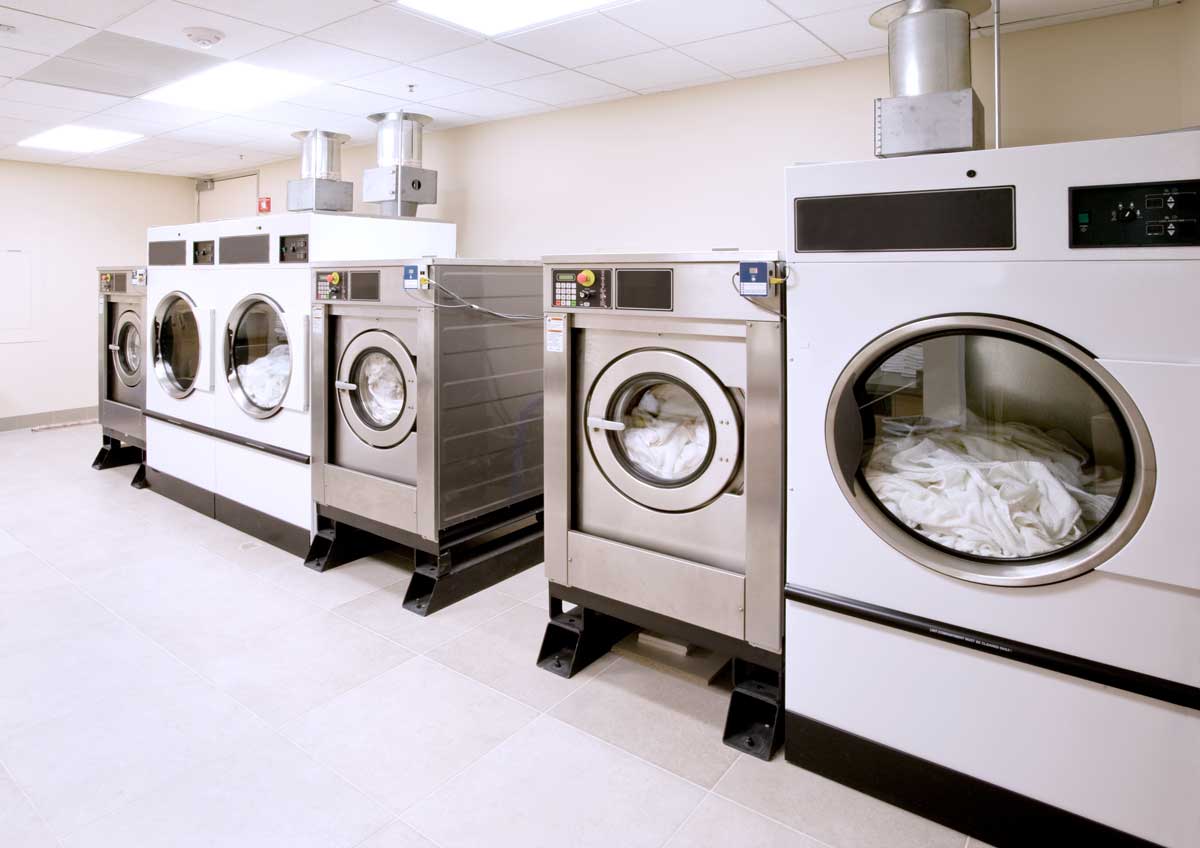
The difference between a hard mount and a soft mount commercial washer comes down to one thing: how the machine handles the violent forces created during high-speed extraction. A hard mount washer is bolted and grouted to a reinforced concrete foundation that absorbs those forces for it. A soft mount washer carries its own internal suspension, so it absorbs the forces itself and can sit almost anywhere, including an upper floor. That single mechanical difference drives everything else that matters: where you can install the machine, how fast it spins water out, what it costs to buy and install, and how it holds up over time.
For most operators the right answer is dictated by the building before budget ever enters the conversation. This guide walks through what each design actually is, how they differ, and a simple framework for making the call with confidence.
What “Hard Mount” and “Soft Mount” Actually Mean
Hard Mount Washers
A hard mount washer has a rigid frame with no internal suspension. During the spin cycle, the out-of-balance forces generated by the drum are transferred straight into the floor. To keep the machine from walking across the room, it has to be bolted and grouted to a thick concrete slab or a reinforced steel base engineered to withstand that load.
Because the design is simple and has no springs or shock absorbers to wear out, hard mount machines are mechanically straightforward, durable, and typically the lower-cost option on the equipment invoice. They are the traditional workhorse of ground-floor laundry rooms.
Soft Mount Washers
A soft mount washer has an internal suspension system, usually heavy-duty coil springs paired with shock absorbers, that isolates the spinning drum from the machine’s frame. Instead of transferring extraction forces into the building, the suspension absorbs and dissipates them, much like a car’s suspension smooths out a rough road.
The result is a machine that does not need the reinforced concrete foundation a hard mount depends on. That is what makes soft mounts so flexible in placement. It is worth being precise about what “no foundation” means, though: anything larger than a residential-size machine should still be anchored to the floor. The difference is that a soft mount is a straightforward bolt-down, not the reinforced slab or steel base and grouting a hard mount requires. That flexibility, plus a more complex build, is why soft mounts carry a higher equipment price.
The Core Differences at a Glance
| Factor | Hard Mount | Soft Mount |
| Foundation | Bolted and grouted to reinforced concrete or steel base | No reinforced foundation needed; larger units still anchored to the floor |
| Vibration transferred to building | High | Very low (suspension absorbs the force) |
| Extraction speed | Typically 100-200 G-force (higher-G models available at higher cost) | Typically 350-450 G-force |
| Installation location | Ground floor only | Ground floor or upper floors |
| Equipment cost | Lower | Higher |
| Installation cost | Higher (foundation work) | Lower (no reinforced foundation) |
| Moving wear parts | Few | More (springs, shocks) |
Installation and Building Requirements (Often the Deciding Factor)
For a lot of operators, the decision is made by the building, not the spreadsheet.
A hard mount washer requires a structurally adequate, ground-level concrete floor. The machine must be bolted down and grouted so it cannot move under load. If you are putting equipment in a slab-on-grade building at ground level, this is straightforward and cost-effective. If you are not, it can be a dealbreaker.
A soft mount washer removes the reinforced-foundation constraint. Because the suspension contains the extraction forces inside the machine, soft mounts can be installed on upper floors, over basements, in mixed-use buildings, and in spaces where pouring or reinforcing concrete would be disruptive or impossible. Larger units are still anchored to the floor, but that is a simple bolt-down rather than a reinforced slab. For multi-story properties, urban buildings, and renovations, this flexibility is frequently the whole reason to choose soft mount. It is also why soft mounts show up in unconventional spots like second-floor utility rooms.
This is exactly the kind of building-versus-equipment tradeoff that benefits from a distributor’s eye before you buy. H-M Company’s facility design and installation team evaluates your floor, your space, and your layout as a system, so you are not discovering a foundation problem after the equipment shows up.
Extraction, Dry Time, and Operating Cost
Mounting type is not only about where the machine goes. It also affects how efficiently the whole laundry runs, because of extraction speed.
Extraction is the high-speed spin that pulls water out of the load before it ever reaches the dryer. It is measured in G-force, and it matters more than most operators realize. The more water a washer removes, the less work the dryer has to do.
Hard mount washers generally extract in the 100 to 200 G-force range, though higher-G hard mount models are available at a higher cost, so that range is a typical baseline rather than a hard ceiling. Soft mount washers, because their suspension can handle much higher spin speeds, commonly reach 350 to 450 G-force. That higher extraction removes more residual water from every load, which translates into:
- Shorter dry times, since the dryer starts with less moisture to remove
- Lower drying energy costs, because dryers run shorter cycles
- Higher overall throughput, since loads move through the dryer faster
One important caveat: the gains flatten out past roughly 200 G-force. There is only so much water that can be pulled out of a load, so a 400 G-force machine does not remove twice the moisture of a 200 G-force machine. The extra extraction still helps, especially at volume, but dry times do not fall in direct proportion to G-force. The biggest improvement happens in the first couple hundred G; beyond that, each additional increment buys a smaller gain. Weigh the higher spin speed against its cost rather than assuming more is always proportionally better.
In a high-volume operation, faster dry times still compound. Dryers are often the bottleneck in a commercial laundry, and the dryer is also where most of the energy gets spent. Pulling more water out in the wash step eases both problems at once. If dryer throughput and utility cost are central to your operation, it is worth reading our guide on gas vs electric commercial dryers alongside this one, because extraction speed and dryer fuel type work together to determine your real cost per load.
Upfront Cost vs Installation Cost vs Lifetime Cost
Comparing only the equipment quotes will point you toward hard mount almost every time, and that comparison is incomplete.
Equipment cost. Hard mount washers are less expensive to buy. Soft mount washers cost more because of the suspension system and higher engineering.
Installation cost. This is where it flips. Hard mount installation requires a reinforced concrete foundation or steel base, plus bolting and grouting, which adds material and labor. Soft mount machines need none of that, so installation is usually faster, simpler, and cheaper. On an upper floor, the cost of building a hard mount foundation may be prohibitive or simply not possible, which removes hard mount from consideration entirely.
Lifetime cost. Over the life of the machine, the higher extraction of soft mounts can reduce drying energy costs load after load. Working the other direction, soft mounts tend to need more maintenance, because the high extraction speeds are hard on the shocks and bearings. Hard mounts, with fewer moving parts, tend to require less service and are exceptionally long-lived in ground-floor settings. The honest answer is that lifetime cost depends on your volume, your utility rates, and your building, which is why total cost of ownership beats any single line item as a decision basis.
The takeaway: do not compare washers on purchase price alone. Compare equipment plus installation plus the operating and maintenance cost each design drives over 10 to 15 years.
Maintenance and Durability
Hard mount washers win on simplicity. With no springs or shock absorbers, there are fewer components that can wear out, which generally means fewer service calls and a longer service life when the machine is properly anchored on a ground floor.
Soft mount washers have more moving parts in the suspension, so they tend to need more maintenance over time. The higher extraction speeds are harder on the shocks and bearings, and those wear components eventually need service. That is not a strike against them; it is the cost of the flexibility and high-speed extraction they provide. With proper preventive maintenance, soft mounts deliver years of reliable, high-efficiency service. The key is having a service partner who knows the equipment and keeps it tuned.
Either way, the brand and build quality matter as much as the mount type. For how the major manufacturers compare across these tradeoffs, see our breakdown of the best commercial laundry equipment brands.
When a Hard Mount Washer Makes the Most Sense
Choose hard mount when:
- You are installing on a ground-floor concrete slab that is structurally adequate or easily reinforced
- Upfront equipment budget is the priority and the building already supports the foundation requirement
- You want mechanical simplicity and the lowest realistic maintenance footprint
- Your operation does not need the highest possible extraction speed to hit its throughput targets
Ground-floor laundromats, on-premise laundry rooms built on slab, and any facility where the foundation is already a non-issue are natural fits for hard mount.
When a Soft Mount Washer Is the Better Fit
Choose soft mount when:
- You are installing above ground level or over a basement, where anchoring to reinforced concrete is impractical or impossible
- You are renovating or working in a mixed-use or older building where foundation work would be disruptive
- Dry times and energy costs are central to your economics, and the higher extraction speed earns its keep in throughput and utility savings
- Floor space and layout flexibility matter, since near-freestanding machines open up placement options
On-premise laundries in hotels and healthcare facilities, multi-unit housing properties with upper-floor laundry rooms, and high-volume operations chasing throughput are where soft mount earns its premium.
How to Decide for Your Laundry: A Simple Framework
Work through this sequence:
- Start with the building. Where will the equipment physically sit? Ground-floor slab, or an upper floor or non-reinforced space? If it is anything other than an adequate ground-floor slab, soft mount may be your only practical option, and the decision is largely made.
- Define your throughput targets. How many pounds or loads per day, and where are your dryer bottlenecks? If you are pushing high volume and dryer capacity is tight, higher extraction relieves the pressure, keeping in mind the gains taper off past about 200 G-force.
- Model total cost, not purchase price. Add equipment cost, installation cost (foundation work for hard mount, none for soft mount), and 10 to 15 years of drying energy and maintenance at your local rates. Compare the full picture.
- Factor in maintenance and service. Do you have a service partner who can keep a soft mount suspension tuned? Hard mount simplicity is an advantage if service access is limited.
- Align with your long-term plan. Are you optimizing for lowest install cost, maximum throughput, building flexibility, or simplest operation? Name the priority, and the mount type usually follows.
If you work through these and still feel stuck, that is exactly where a specialist distributor helps, by reviewing your building, your washers and dryers, your volume, and your budget as one system rather than as separate line items.
Plan Your Next Step with H-M Company
Hard mount vs soft mount is not a question of which design is universally “better.” It is a question of which one fits your building, your volume, and your economics. A ground-floor laundromat on a solid slab and a hotel laundry on the third floor will rationally make opposite choices, and both will be right.
Use this guide alongside H-M Company’s main Commercial Laundry Buying Guide to:
- Match the mount type to your building’s structure and your layout
- Understand how extraction speed connects to dry times, utility costs, and throughput
- Frame the cost conversation around total cost of ownership, not just the equipment quote
From there, H-M Company can help you spec the right washers and dryers, design a layout that fits your space, and build a preventive maintenance plan that keeps the equipment performing for years. We have helped laundromat operators and facility managers across Ohio, Kentucky, Indiana, West Virginia, and Western Pennsylvania get this decision right from the start. Contact our team to talk through your specific building and volume.
